Genomic Alterations in Advanced Lung Cancer Patients Compared via CGP and Hotspot Panel Test in a Bangladeshi Tertiary Hospital
Published on September 18, 2025
01 Research Methods
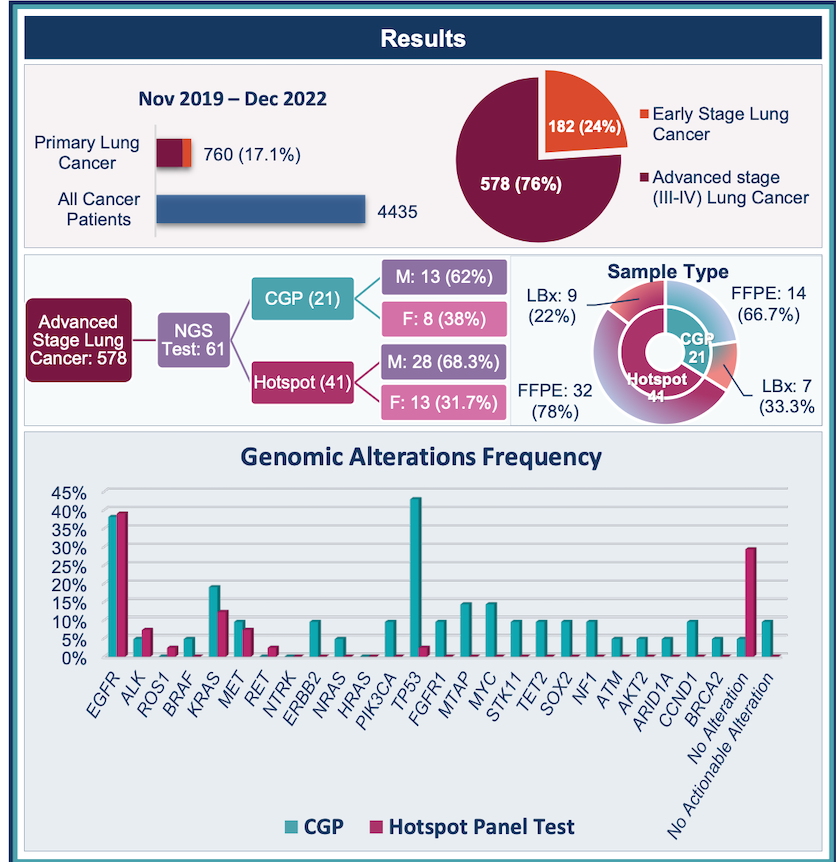
In this retrospective observational study, the preliminary data were collected from hospital information system containing 4435 oncology OPD cases. Genomic alteration data were collected from test reports of 62 advanced lung cancer patients who underwent NGS testing between Nov 2019 and Dec 2022. CGP was performed on 21 patients, while 41 patients were tested using Hotspot panel. The tests were done using tissue samples or liquid biopsy when tissue samples were unavailable.
02 Key Results
Among 4435 oncology OPD cases, 760 (17.1%) cases were of primary lung cancer, and 76% were presented in stage III-IV. CGP identified more actionable genomic alterations than the Hotspot panel test, including PIK3CA, FGFR1, MTAP, MYC, STK11, NF1, ARID1A, CCND1, BRCA1/2, etc. The probability of identifying no genomic alterations was higher in the Hotspot panel test (29.3%) than in CGP (4.8%).
03 Conclusion
The study found that the probability of detecting actionable genomic alterations in advanced lung cancer patients is very high with CGP compared to Hotspot panel. CGP can also identify novel or uncommon genomic alterations that may have clinical significance. While the cost of CGP is higher than Hotspot panel, it should be preferred if the patient can afford it. The findings from CGP may have important implications for patient management and personalized treatment approaches in Bangladesh. However, the sample size of this study is limited to represent a country picture. Therefore, larger studies are needed to confirm these findings and to establish guidelines for genomic testing in advanced lung cancer patients in Bangladesh.