2842 Clinical Implementation And Outcomes Of SRT/SBRT With Linac-Based VMAT Technique In A Less Resourced Country- A Single Center Experience
Published on September 18, 2025
01 Research Methods
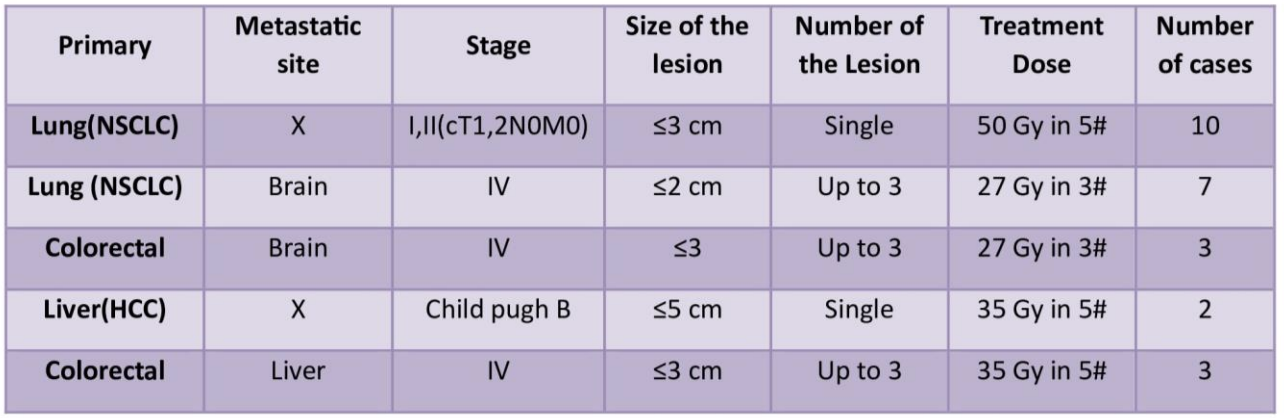
The study involved 25 patients: 10 with intracranial lesions treated with 27 Gy in 3 fractions, 10 with lung lesions treated with 50 Gy in 5 fractions, and 5 with liver lesions treated with 35 Gy in 5 fractions at Labaid Cancer Hospital & Super Specialty Center, Dhaka, Bangladesh from May 2023 to August 2024.
02 Key Results
A total of 25 patients were included (Table 1). Most patients were male (76%, n=19). Median age was 43 years (range 35-59). ECOG performance status was 0-1 in 21 patients (84%). The majority of patients 13 had metastatic disease(stage IV: 13 (52%)). OAR doses remained within tolerance limits, and QA results demonstrated excellent agreement between planned and delivered doses, achieving gamma pass rates of 99.3%±0.68 (3%/1mm) for octavius 4D and 99.6%±0.4 for portal dosimetry. Median follow-up was 12 months (range 3-18 months). Notably, treatment responses were excellent, with no local residual/recurrences observed. Though there was four patient who developed new site of recurrences. Among 4 patients 2 died of distant recurrences. 1yr Local Control (LC), Progression-Free Survival (PFS) and Overall Survival (OS) were 100%, 84% and 92%, respectively. No G3 acute toxicities were observed.
03 Conclusion
This study highlights the effectiveness of Linac-based VMAT for SRT/SBRT in managing brain, lung, and liver lesions, achieving superior local control and impacting overall survival. The integration of advanced imaging, precise dosimetric planning, and robust quality assurance makes SRT/SBRT as a reliable and impactful treatment modality in modern radiation oncology.